

Outdoors Tomorrow: Carp
And a new poll!

Here’s another poll…
And the results so far of yesterday’s poll. It looks like Stewart’s Shops is going to be the winner!

And today’s Scrabble Gram — can you make a 7-letter word out of these letters?
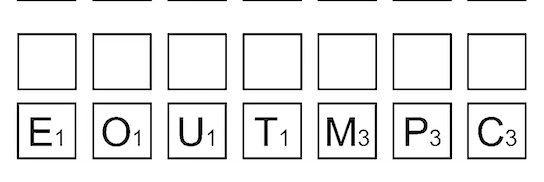
You have three minutes! Answer at the end!
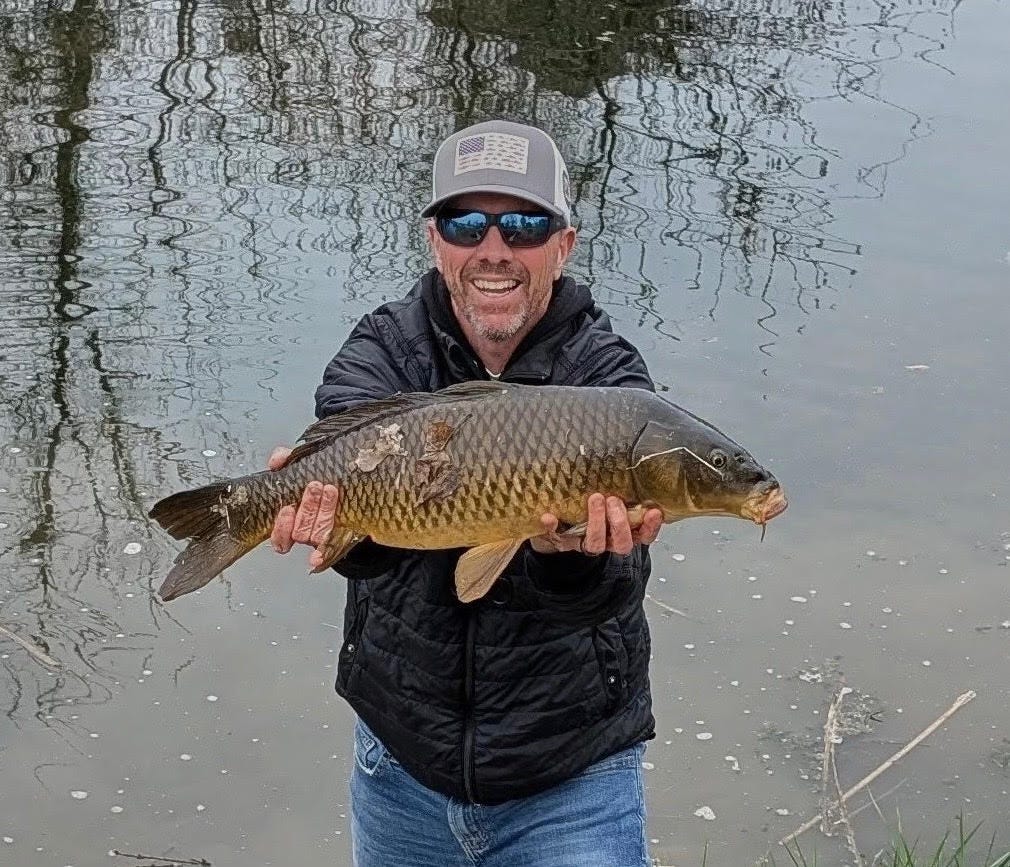
Outdoors Tomorrow: Carp
By Bob Henke
Journal & Press
It is a well-known fact that men work pretty much all their waking hours, unlike another segment of society that spends vast amounts of time on leisure activities like shopping on-line, applying various sorts of lotions, potions, and paint to various locations on their bodies, watching fake reality shows, and recreational death-scrolling on the phone. The point is, when a man actually takes a moment to himself, it is cosmically unfortunate if he is heckled during one of these interludes (another recreational activity enjoyed by the distaff segment of society.)
Therefore, one must have no end of compassion for poor Gord Shuvell of Winnipeg.
This unfortunate fellow had spent the day under the unrelenting horrible workload of hunting camp when he finally decided to take a couple minutes to himself to reflect upon the world. He was in the outhouse with the door open so he could contemplate the view. This was not the run of the mill outhouse either, it had a nice bench to rest your outstretched feet as you reclined—they called it the “poopstool.” So there he was, looking over his pants at the lovely mountains when his view was obstructed by the head of a bear. The gender of the bear was not specified but I bet it was female for it became enraged at seeing a man sitting down. It grabbed his pants, ripped them off, then grabbed poor Gord by the head and dragged him 50 feet off into the woods. Gord, of course, bellowed about this turn of events, which alerted one of his friends. When he heard his friend’s voice, he knew what was going to happen next so he buried his face in the muskeg and covered his ears. A loud boom followed and the bear dropped off Gord. Hopefully its final realization was that it is inappropriate to molest a man at leisure.
I was spending a rare moment of leisure myself, contemplating Gord’s misfortune, when I was interrupted by a jangling telephone. I would have preferred a bear but it was someone who wanted to rail about something I had said about invasive species. Over the course of 21 minutes and 40 seconds, according to the timer on my telephone, this lady went on while I spoke not a single word. The problem was, I had no idea what her stance was, for on one hand she wanted to either outlaw or eradicate everything but on the other she did not want to spend a single tax dollar achieving this. When she finally ran down, I asked, reasonably I thought, exactly what she felt I should advocate when I spoke to our state and federal representatives. She said, “I don’t know BUT if you get it wrong, I will not vote for you in December,” and abruptly hung up.
I did not feel particularly threatened by this since the election takes place in November but the whole fracas called to mind the fact that non-native species have been used to influence elections for many years. American gray squirrels were presented to the court in England and Spain in return for titles. Red foxes were given to American governors to secure favorable land grants. However, one of the most direct instances of electoral bartering, with the most profound result, involved the common carp.
The common carp is a minnow, native to Asia and Europe, but now it has spread through all North American waterways. We have to refer to it as the “common carp” because there are now several other carp species that have been released to North American waters fairly recently.
The common carp looks like a giant goldfish with sensitive barbels at the mouth and a heavy armor of large bronze-colored scales. The largest carp found to date was an 84 pound monster netted in South Africa (carp were introduced elsewhere in the world as well.) There are numerous state records in the 60 pound range. These include a 67lb 10oz 47” long common which was killed by bow & arrow in 2011 from C.J. Strike Reservoir, Idaho; a 61lb 8oz fish, which was speared by Dale France in Wolf Lake, Michigan in 1974 and lastly, in Virginia, the records show a 60lb carp was killed with an arrow from a private pond in 1970. Some states like Wisconsin keep two sets of records. One for rod & line (57lb 2oz) as well as other methods such as bowfishing (59lb 2oz). One of the more recently authenticated big carp was that killed by a bow-hunter in California in 2013 and weighed in at 67.40 lb. The New York State record for common carp is 50 pounds 5 ounces, set in 1995 by Charles Primo Sr. at the Tomhannock Reservoir in Rensselaer County but there is an abundance of 20 pound fish in many waters throughout the carp’s range especially Lake Champlain and the Great Lakes. The next record 50 pounder may be just one dough ball away.
Europeans hold carp in high regard as a game fish. Carp fishermen over there there are a snooty lot. There are periodicals devoted to the latest advances in carp tackle, called “rig” by the in-crowd. There are stories of wily monsters single-mindedly pursued, and mythical quests and awards given for the fish taken under the most trying conditions.
Fast-growing carp have been farmed since the early Bronze Age with selectively bred strains developed in diverse areas from Siberia, France, Greece and Israel to Southeast Asia. The UN sponsors carp farming in protein-starved countries because an acre of pond produces 300 pounds of edible carp flesh annually.
Here, we do not think so highly of them. Our first carp came in 1876 when 345 fish were obtained as a gift from Germany. The U.S. Fisheries Commission wanted to study the fish for possible introduction into U.S. waters but the carp were breeding so rapidly there was quite a supply. Elected representatives began shipping carp to valued constituents as a way to curry favor. In fact, tax dollars paid for specially refrigerated railroad cars used to distribute the scaly vote-getters nationwide. Before some of the politicians’ terms were up, carp were taking over many waters, crowding out native fish, uprooting vegetation, and making a general muddy mess. Americans were not so dilettante as Europeans, taking carp with everything from gill nets to dynamite, but it did not slow down the carp one little bit. They live up to 20 years in the wild and one was held in captivity to the advanced age of 47. They can tolerate water temperatures up to 96 degrees for short periods and have been chipped out of blocks of ice, thawing out apparently none the worse for wear. Female carp are world-class egg layers, averaging 150,000 eggs per pound of body weight and they grow faster than any other freshwater fish, putting on three pounds per year for prolonged periods. Today carp are the most widespread fish species found on this continent and we think of this as normal, never missing the displaced native species because we never knew them.
Guess I will go contemplate the wisdom of mixing biology with politics …

Contact Bob Henke with your sightings or questions by mail c/o The Greenwich Journal & Salem Press, by email at outdoors.tomorrow@gmail.com or on Facebook.
And Now for the Comics …
‘Motto’ by Chris Smith

‘9 to 5’ by Harley Schwadron

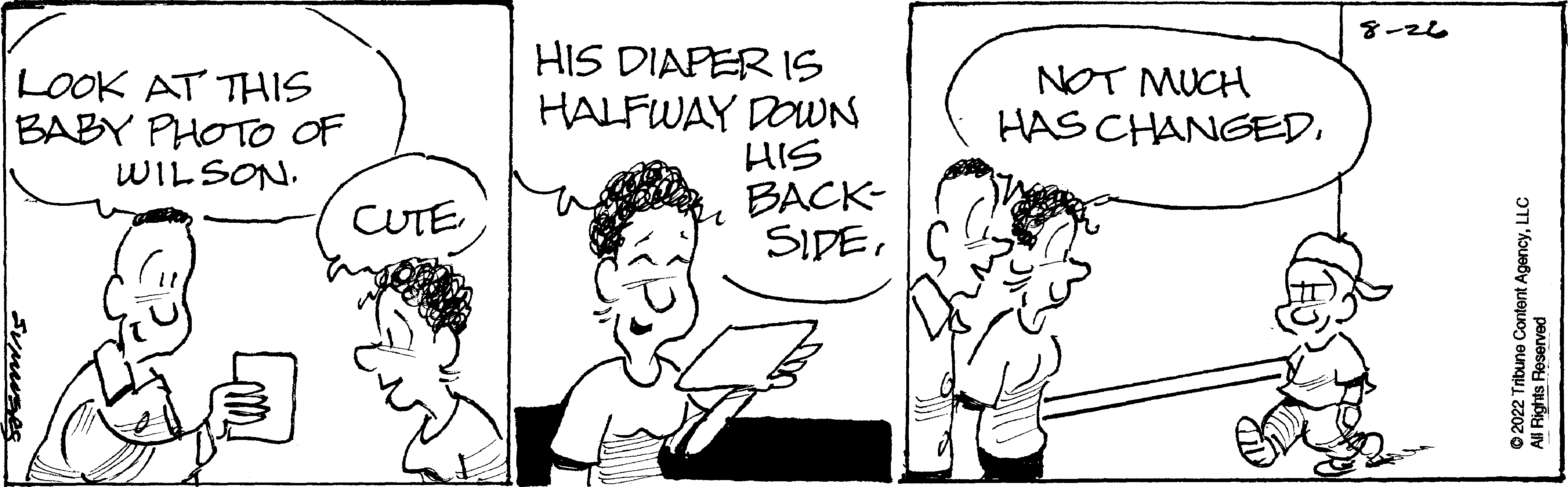
‘The Middletons’ by Dana Summers
And that Scrabble answer…

More tomorrow!
‘
We lived in Germany for a few years when my husband was stationed there. Whenever a town would have some kind of festival, along with the beer and bratwurst there would be a long rut filled with charcoal with stakes on either side leaning over it and on each stake would be a whole roasting carp. They smelled and tasted delicious, if a bit bony. But they were big enough so that the bones were pretty easy to pick out. If invasive carp are a problem, it would seem there’s an easy fix, as long as the water they come from isn’t polluted!
Really enjoyed Bob Henke’s article.